
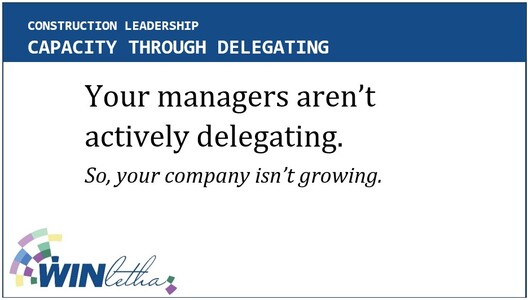
So, your company isn’t growing.
If your Project Managers say they just don’t have the “extra time” to develop people or pursue new work, the issue may be what work they’re still holding onto.
Perhaps they’re attending every meeting. Writing every first draft. Making every presentation. Staying connected to every stakeholder. Making sure every update is consistent.
They may have an Assistant Project Manager or a Project Coordinator who is capable of doing more. But the PM continues to hold onto the work. And when you ask why, you may hear:
- “It’s faster if I just do it myself.”
- “The schedule is too tight for them to learn right now.”
- “We can’t afford mistakes on this.”
- “I still have to correct what they’re already doing. Why would I add more?”
Those are understandable answers in the short term, especially in an environment that emphasizes billable hours and tight margins.
But they create an operational problem.
Emphasis on efficiency limits tomorrow’s capacity
Delegation is often treated as a time-management skill: give something to someone else, free up your calendar, and move on to other work on the never-ending To Do list.
But in a growing construction company, delegation is a more nuanced skill – it’s meant to create capability and capacity.
When the PM continues to attend every meeting, the APM gets limited exposure to key stakeholders. When the PM writes every first draft, the APM gets fewer opportunities to develop judgment about what good work looks like.
It creates an environment where the PM doesn’t have time to pursue new work and the APM isn’t ready to take on more responsibility. The organization can’t confidently tee up either of their next roles because there isn’t enough demonstrated capacity.
Delegating is inherently risky, and PMs are trained to minimize risk
It’s tempting to say: “They just need to delegate more.”
Sometimes that’s true.
But if you’ve already told them that – and nothing has changed – then it may be worth asking: “What makes delegation feel risky?”
For someone who has built their career through technical excellence, releasing control can be very uncomfortable.
A PM has been rewarded for knowing the answers, catching the mistakes, producing excellent work, and being the person others could rely on.
Now their leadership role asks them to do something different.
They need to create the conditions for someone else to develop the judgment, produce the work, and become someone others can rely on.
And they need to try this new skill without dropping the ball in the other ways they bring value. It feels like it’s an additional responsibility beyond what already fills their regular work hours.
A manager may fully understand that delegation develops people. But when the client is waiting, the deadline is approaching, and the cost of a mistake feels high, the safest choice can seem obvious: “I’ll just do it myself.”
Their duty is to be safe and fast, so delegating gets pushed, again.
An environment with hybrid and AI tools is a tough place to release control
There are fewer ways to control the process of delegating today, which also heightens the risks.
It’s no longer the case that a PM can see at a glance if a PC is energized or exasperated, if they’re working on the whiteboard or just staring at it, or if they are checking resources or going in circles with limited information. A PM has fewer opportunities to casually check-in on the direction of a task while assuring that they aren’t taking it back. And a PM used to know the other people that the PC might also turn to, and what they might offer, but now there is instant messaging with people all over the globe.
In our environment of hybrid working and AI tools, it is notably harder to contain what happens after you hand something over. And it’s easy to miss the entire part between assigning it and getting it back.
The return on leadership coaching is operational
In coaching, we can talk through what they are assuming about the business priorities and what they are worried will happen. We’ll explore observations versus judgments about another person’s abilities, what level of autonomy is appropriate, and what “good enough” may mean in the situation. We’ll consider what it means for the manager if their staff can do the task without them.
And we’ll affirm what techniques they already know for delegating tasks and responsibilities, what has worked before, and what could be tried next.
It’s an iterative process, growing more awareness, curiosity, and competence.
The goal isn’t simply to get a PM to hand off a meeting or a first draft.
It’s to help them become more willing and able to:
- release control appropriately;
- build capability in others;
- tolerate the learning curve;
- learn from the outcome; and
- take on higher-value responsibilities themselves.
That’s leadership capacity.
The return is in seeing an APM represent a project confidently, hearing a PM have a business development conversation, and getting interim updates from various members of the team.
A question for you
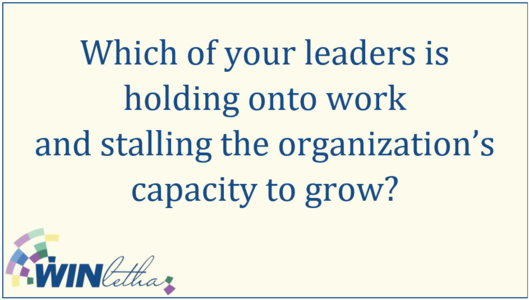
Which of your rising leaders is currently holding onto work that someone else could be learning to own, and what is happening operationally as a result?
It may be that your manager has spent years being rewarded for technical excellence and hasn’t yet developed a different relationship with control.
Let’s have a short chat about how you can help them build the judgment and confidence to release control in an uncontained environment.
Check out this short video about a client who struggled with delegation.