
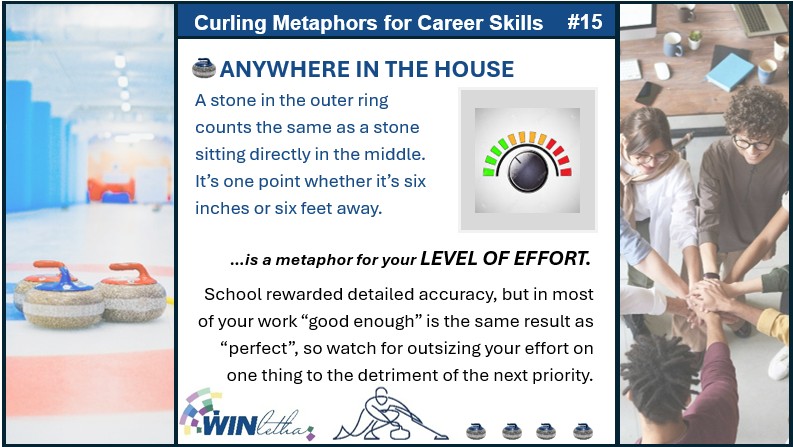
In curling, a stone only needs to be touching the house to score.*
It doesn’t have to sit perfectly on the button. It doesn’t need to be flawlessly centered.
If it’s in the outer ring and closer than your opponent’s stone, it counts the same: one point.
Six inches or six feet from the center – the scoreboard doesn’t care.
That’s a powerful leadership lesson.
The Accuracy Habit
Many professionals were trained in environments where precision was everything.
In school:
- The exact answer mattered.
- Extra detail earned higher marks.
- Thoroughness was rewarded.
- The margin between 97% and 100% mattered.
That conditioning sticks.
But in professional settings, not all tasks are graded equally.
Some tasks require precision. Others only require sufficiency.
And treating them the same can drain your energy and slow your progress.
Effort Is a Resource
Your time, attention, and mental energy are finite.
When you invest maximum effort in something that only requires “in the house,” you steal energy from:
- The next decision
- The next client
- The next strategic conversation
- The next opportunity
Overextending on lower-impact tasks often shows up as:
- Polishing slides no one will scrutinize
- Refining wording that won’t change the outcome
- Reworking something already approved
- Adding analysis beyond the decision threshold
Perfection feels productive.
But misallocated effort is expensive.
The Leadership Shift
As you grow into broader leadership, your job is not to perfect every stone.
It’s to:
- Allocate energy strategically
- Sequence priorities effectively
- Protect capacity for what truly requires precision
Ask yourself:
- Does this require “on the button”?
- Or does it simply need to be “in the house”?
Executive maturity shows up in restraint.
When Precision Does Matter
This is not an argument for mediocrity.
Some stones must be exact:
- Safety standards
- Contract terms
- High-stakes client commitments
Discernment is knowing which shots those are.
The Cost of Overdelivering
High performers often pride themselves on exceeding expectations.
But if you deliver 110% on Task A, and then rush Task B because you’re depleted, the net impact may be lower than if you had allocated effort with intention.
Consistency beats spikes of excellence followed by exhaustion.
As the Games continue…
This is the fifteenth in a 20-day Olympic curling series exploring leadership lessons hidden in the sport.
Tomorrow’s lesson looks at not just giving instructions, but giving clarity in a shot call.
Until then, remember: Inside the house still counts. Match your effort to the impact. 🥌
* Per Rule R12(b), at the completion of an end (when all stones have been played), a team scores one point for each of its own stones located in or touching the house that are closer to the tee than any stone of the opposition. To determine if a stone is actually touching the house, a specially-designed 6′ measuring stick is placed on the tee and if it makes contact with the stone, then it counts. If teams cannot visually decide which stones are closer to the tee, or whether a stone is touching the house, a measuring device is used. “Take the stick to them” refers to getting the calibrated measuring stick out that can help show which is closer. The few minutes taken for a measure can feel like a dramatic pause in the action. Further drama and more detailed rules come into play in the rare situations when two stones measure exactly equidistant or are too close to the center for mechanically or visually measuring.
** During a round of broom-stacking (putting the brooms down and socializing), a wistful topic can be about an obscure rule (that was leveraged in the 2002 film “Men with Brooms” – highly recommend!) Per the 1890 General Rules of the Game, Rule 7 says: “Should a stone happen to be broken, the largest fragment shall be considered in the game for that end – the player being entitled to use another stone, or another pair, during the remainder of the game.” Back then, the wide array of materials used and various techniques and tools available to make the stones and handles, plus the tendency for stones to fall through the ice and be dragged out later – breakage was likely common. Modern manufacturing of curling stones includes a lot of quality control, making breakage rare (I don’t recall any stones breaking since I’ve been playing), but we still have a version of the rule (just in case?) – R2(c) “If a stone is broken in play, the teams use the “Spirit of Curling” to decide where the stone(s) should be placed. If agreement cannot be reached, the end will be replayed.”