
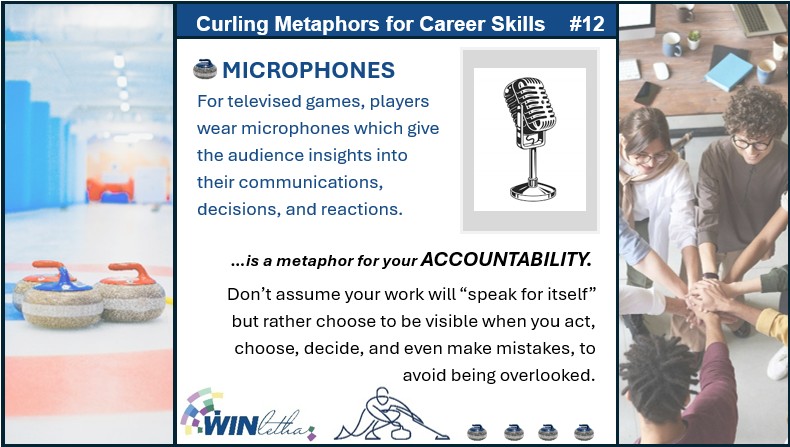
In televised Olympic curling, players wear microphones.
As viewers, we hear:
- Strategy conversations
- Real-time adjustments
- Disagreements
- Encouragement
- Frustration
- Accountability
That much required visibility adds pressure.
But it also adds clarity.
The Myth of “It Speaks for Itself”
Many professionals were taught a quiet rule: Work hard, and your results will speak for themselves.
In reality, work rarely speaks without translation.
Decisions happen in meetings. Credit shifts in conversations. Opportunities go to those who are seen as contributors.
If no one hears your reasoning, your ownership, or your learning, your impact can be underestimated.
Visibility Isn’t Ego
In curling, microphones aren’t about showmanship. They’re about transparency.*
You hear players say:
- “That was heavy. My fault.”
- “Let’s adjust the line.”
- “I like that call.”
- “I missed that read.”
That is accountability in real time.
They don’t wait for the final score to explain themselves. They narrate decisions as they happen.
Accountability Is Audible
When you:
- Explain your thinking
- State your recommendations clearly
- Share lessons from a misstep
- Credit others out loud
- Clarify trade-offs
…you are turning the microphone on.
This does three things:
- Builds trust
- Builds credibility
- Prevents you from being overlooked
Silence can be misinterpreted as disengagement.
Especially for Emerging Leaders
As professionals move into leadership, particularly in industries where visibility has not historically been evenly distributed, assuming merit will naturally be recognized can stall momentum.
Being visible about:
- Decisions
- Standards
- Expectations
- Corrections
- Values
…helps others understand how you lead.
It also models accountability for your team.
What This Looks Like at Work
Turning the microphone on might mean:
- Sending a recap that outlines your reasoning
- Speaking up about a risk you see
- Sharing a lesson learned after a project
- Publicly owning a mistake before someone else points it out
- Clarifying how credit should be distributed
It’s not about self-promotion. It’s about making your thinking visible.
As the Games continue…
This is the twelfth in a 20-day Olympic curling series exploring career and leadership lessons hidden in the details of the sport.
Tomorrow’s lesson looks at discernment, and why curlers talk about the err side of the shot call.
Until then, don’t assume your work will speak.
Turn the microphone on. 🎙️🥌
* Many curlers have been interviewed about how they feel about being mic’d up. Typically they say that it is initially strange, but quickly becomes just part of playing the game. They mention being careful about not swearing, but otherwise don’t hold themselves back from talking about strategy, connecting with team mates, and venting as needed. John Shuster has said that “having a mic on just reminds me of trying to be the person that I strive to be, as opposed to sometimes letting emotions get the best of you.” Matt Hamilton has said that “the fact that you get to know exactly what’s running through our heads out on the ice just makes us more relatable.”
** As the technology was initially rolled out, curlers may have found themselves in “the” televised game with two or three players per team wearing microphones on that sheet, and the other games carrying on quietly. Fairly soon though, the microphones were on all players, in all concurrent games, with the possibility of the cameras and the attention moving to any game if the spotlight game finished early. Now that streaming technology has become reliable, every game is being microphoned and broadcast and/or streamed for all to hear. Some curling pants are even now designed to accommodate the mic pack.