
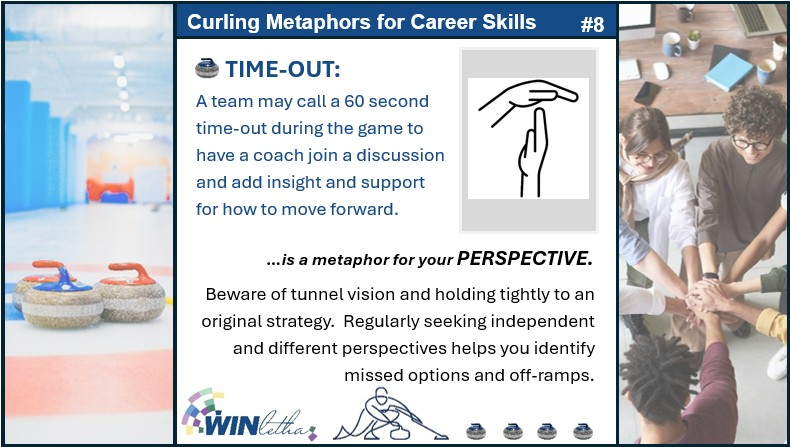
In curling, teams are allowed a single sixty-second time-out during a game.*
When they use it, a coach joins the discussion on the ice. The team pauses play, steps out of the intensity of the moment, and invites an outside perspective before deciding how to move forward.
It’s brief. It’s intentional. And it often changes the game.
Why the time-out matters
In the middle of competition, tunnel vision is real.
Players are close to the action, invested in the outcome, and often attached to a strategy they’ve already committed to. The coach, by contrast, sees the whole sheet. They’re less emotionally entangled and more able to spot alternatives.
The time-out doesn’t replace the team’s judgment. It expands it.
The workplace version of tunnel vision
At work, pressure narrows perspective in similar ways.
You may notice it when:
- You keep refining the same plan despite diminishing returns
- You dismiss alternatives because they don’t fit the original strategy
- You feel compelled to “push through” rather than reassess
- You assume speed is the only way forward
In these moments, perspective, not effort, is usually what’s missing.
Why outside views unlock options
Independent perspectives help surface:
- Blind spots you’ve normalized
- Assumptions you didn’t realize you were making
- Options you ruled out too early
- Off-ramps that reduce risk
This doesn’t require formal coaching (though that helps.) It can come from a trusted peer, mentor, or someone outside your usual circle.
The key is difference – not agreement.
Knowing when to call your own time-out
Consider pausing when:
- Decisions feel heavier than they should
- Progress has slowed without clear reason
- Stakes have changed but the plan hasn’t
- You’re defending a strategy more than evaluating it
A short pause to reset perspective can prevent much longer recovery later.
As the Games continue…
This is the eighth in a 20-day Olympic curling series exploring career and leadership lessons inspired by small details of the sport.
Tomorrow’s lesson looks at the core value supported by the hammer.
Until then, notice when speed is pulling you into tunnel vision… and don’t hesitate to call the time-out. 🥌
* Players signal a time-out simply by using a “T” hand signal (Rule C7(c)ii.) They may aim this signal in a few directions until they are sure that the umpire and the manager of the clock both see it, and that the team’s clock stops. The 60 seconds is meant to be the time the team has with the coach present, so the Chief Umpire will determine before the event starts, a reasonable amount of time for a coach to reach the furthest house. This travel time will occur first and then the 60 seconds will start (whether the team has a coach or not.) When the time-out has expired, the coach needs to stop conferring, but the team can continue to talk if they want to, with their clock running again. Similarly, the team doesn’t need to wait out the full time-out stoppage. They can throw their stone before the time-out expires.
Another kind of time-out is the technical time-out which stops both clocks. This is sometimes indicated by players forming a cross with their arms. A technical time-out happens when requesting a ruling (ex. if a stone is a free guard or touching the house), when needing to tend to an injury, when a stone handle malfunctions or feels loose, and other extenuating circumstances. Yet another metaphor for noticing when things don’t feel right, and asking for a moment with others to understand the situation better.