
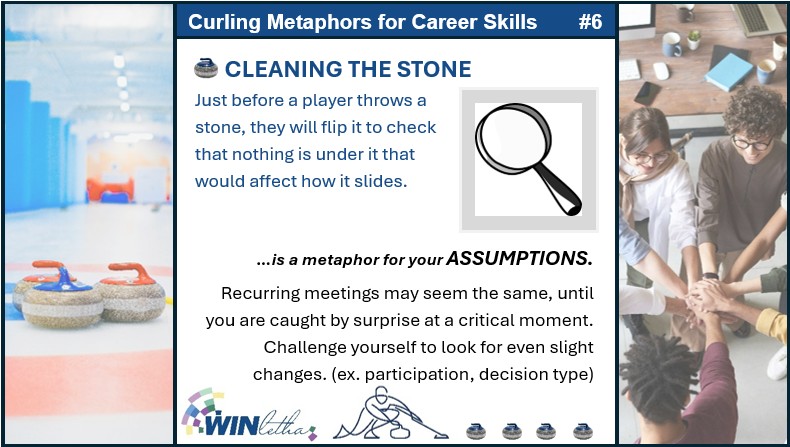
Just before delivering a stone, curlers do something that looks almost unnecessary.
They flip the stone over and quickly check the bottom.
Most of the time, there’s nothing there. But sometimes – just sometimes – there’s debris.* A piece of lint, a hair, or a small bit of dirt could change how the stone slides, curls, or stops.**
That tiny particle is enough to alter the outcome of the shot, and possibly the game.
So players check, every time.
Why this ritual matters
Curling is a game of precision. Players spend years refining technique, reading ice conditions, and coordinating strategy.
Letting a small, preventable variable go unchecked would undermine all of that preparation.
The habit isn’t about distrust. It’s about respect for uncertainty and minimizing assumptions.
The workplace version of the same risk
In professional life, assumptions creep in quietly, especially around familiar routines.
Recurring meetings are a common example:
- Same participants
- Same cadence
- Similar agendas
Over time, it’s easy to assume:
- Engagement levels are the same
- Stakeholders are aligned
- Context hasn’t shifted
- Decision steps haven’t changed
Until one day, you feel you’re going sideways.
A missed cue. A dissenting voice. A lack of participation. A decision that turns out to be bigger than expected.
The surprise isn’t caused by negligence. It’s caused by autopilot.
Assumptions reduce awareness
Assumptions save energy in the short term, but they narrow attention.
When we assume “this is just like last time,” we stop noticing:
- Who is participating differently
- Where tension is showing up
- Whether the meeting is informational or decisional
- What’s happening beneath the surface
Like debris under a stone, small subtle changes can have a large impact.
A simple practice to clean the stone
You don’t need to question everything, just enough to stay present.
Before a familiar interaction, try asking:
- What’s different this time?
- What decision, if any, is actually being made?
- Who needs to be more engaged than usual?
- What assumptions am I carrying in?
That brief pause restores awareness without adding complexity.
As the Games continue…
This is the sixth in a 20-day Olympic curling series exploring career and leadership lessons inspired by small details of the sport.
Tomorrow’s lesson shifts from assumptions to creativity– and how there is more than one way to reach a goal.
Until then, notice where routine has quietly replaced awareness… and take a moment to clean the stone. 🥌
* When debris impacts a stone, it’s called a “pick”. It can be under the stone before delivery, or the stone can go over something while it’s sliding. You may see players cleaning the ice where they expect their next stone will travel, and even where they expect a soon-to-be-hit stone to travel. When players say “Clean” as a stone is sliding, they are encouraging their sweepers to lightly sweep in front of the stone to minimize the chances that it catches debris. When a stone veers sharply or stops suddenly, the players will often lament that “it picked.” Players will use lint rollers, and even walk on similar sticky pads to catch debris off their shoes, and they rarely use pockets. Picks don’t happen often, but with air blown from mechanical ducts and humidifiers, and equipment like shoes that start to deteriorate, picks will always be possible.
** There is another aspect to the topic of debris, that is referenced in Rule R8(a). “Sweeping can be in any direction, the brush head must not be raised in front of a moving stone, must not deposit debris in front of a moving stone, and sweeping must finish to either side of a stone.” There are rare scenarios when a ‘pick’ could be beneficial, such as a stone that is travelling too far, could be slowed or stopped by debris. So it is against the rules to intentionally manufacture a pick. Like sweeping your kitchen floor and not leaving the pile of debris right where you would step on it instead of to the side, in curling, sweepers can’t finish their sweeping motion right in front of the rock to then slide over any debris pile created. Sweepers must finish their final motion to the side. We like to believe that cheating doesn’t happen in curling, but it’s a sport so it’s not immune, and if anyone tries to cheat this way, it may be too subtle for an opponent or official to confidently flag it as a rules infraction for ‘dumping’.