
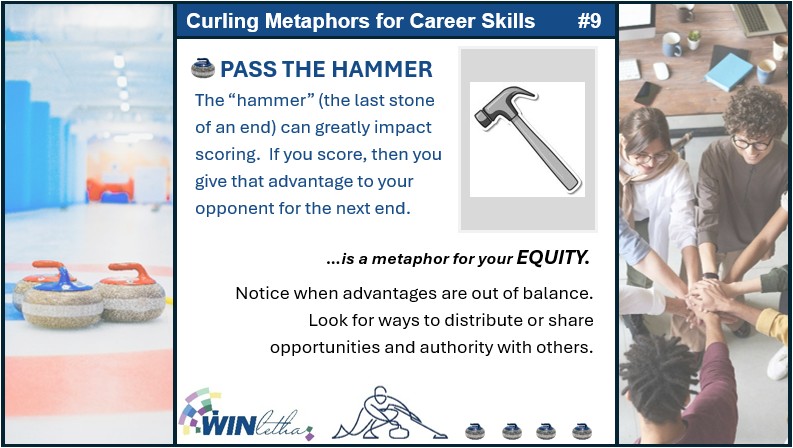
In curling, one stone carries outsized importance.
The hammer – the last stone of an end – often determines who scores and how much. Teams with the hammer have a strategic advantage, especially in close games.
But here’s the twist: If you score, you give the hammer to your opponent in the next end.*
Advantage is powerful – but it’s never permanent.
Why the hammer is shared
Curling’s structure prevents one team from holding all the power indefinitely. It keeps the game competitive, dynamic, and engaging.
Teams must decide not only how to use the hammer, but when to score, when to take risks, and when to limit damage.
The best teams think beyond the current end.
The workplace version of the hammer
In organizations, advantage shows up in many forms:
- Decision-making authority
- Visibility and voice
- Access to information
- Control over opportunities
Unlike curling, these advantages aren’t always designed to rotate. They can accumulate quietly – and unevenly.
That imbalance often isn’t intentional. But over time, it affects:
- Engagement
- Trust
- Development
- Team resilience
Equity isn’t about losing power
Passing the hammer doesn’t mean giving up leadership.
It means recognizing that:
- Shared authority builds capability
- Distributed opportunity develops others
- Rotating advantage strengthens the system
Leaders who always hold the hammer become bottlenecks. Those who pass it create momentum that lasts beyond them.
What “passing the hammer” looks like at work
It can be simple:
- Letting others lead key discussions
- Sharing visibility with teammates
- Delegating decisions and responsibilities, not just tasks
- Creating stretch opportunities intentionally
Equity isn’t a zero-sum game. When more people can influence outcomes, performance improves.
As the Games continue…
This is the ninth in a 20-day Olympic curling series exploring career and leadership lessons inspired by small details of the sport.
Tomorrow’s lesson looks at the big effect that tiny water droplets can have on resistance.
Until then, notice where you’re holding the hammer… and consider when passing it might strengthen the whole team. 🥌
* The modern rule R5(a) says that the “order of play shall be maintained until one team scores, after which the team that most recently scored delivers the first stone in any subsequent end.” The “General Rules of the Game” circa 1860 say “4. The skips opposing each other shall settle by lot, or in any other way they may agree upon, which party shall lead at the first head, after which the winning party shall do so.” In Mixed Doubles, if you have the hammer and no one scores points (known as a blank), then the hammer is still passed to the other team, so an even higher level of equity.
Because the hammer is valuable, teams want to clearly determine who gets to start the game with it. Rule R5(a) also says “Unless predetermined or decided by the Last Stone Draw (LSD), the teams opposing each other in a game shall use a coin toss to determine which team delivers the first stone in the first end.” This coin toss is similar to the 1860 ‘settle by lot’. At the Olympics, in round robin games, they decide by Last Stone Draw – draw being the kind of throw that stops in the house. Each team will have pre-game practice and will then throw stones to the button to be measured for how close they are to the very center of the rings. The team that gets closest will earn the last stone (hammer) and you’ll see a star (or a hammer icon in other events) next to their name on the scoreboard to show this fact.