
One of the most surprising things about curling ice is that it isn’t smooth.
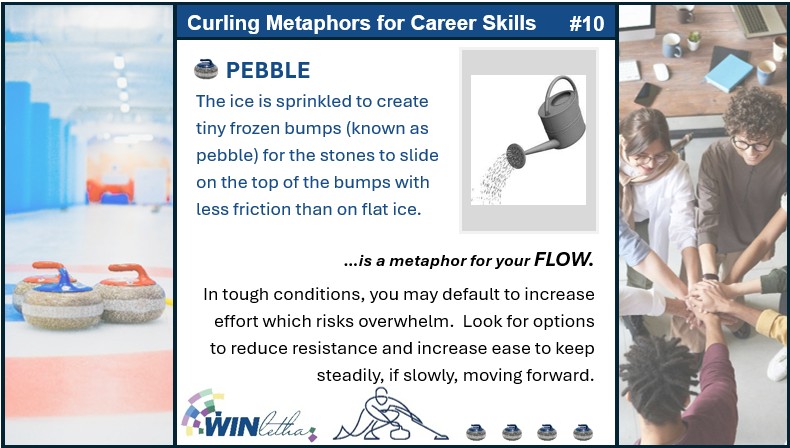
Before a game, the ice is sprinkled with water droplets that freeze into tiny bumps.* This texture (called pebble) allows the stone to glide on top of the bumps, reducing friction compared to flat ice.
It looks rougher. But it performs better.
Why pebble creates flow
Without pebble, stones would drag and slow unpredictably, and not go very far at all.
With it, players can:
- Use less force
- Predict movement more accurately
- Maintain consistency across the game
The pebble doesn’t eliminate effort, it optimizes it.
The workplace instinct to push harder
When work feels heavy or stalled, many professionals default to increasing effort:
- Working longer hours
- Adding more meetings
- Tightening oversight
- Applying more pressure
Sometimes that’s necessary.
But often, the real issue isn’t effort. It’s friction.
Friction shows up as:
- Contradictory expectations
- Unclear approvals
- Competing priorities
- Misaligned incentives
More force against high friction usually leads to exhaustion, not momentum.
Creating your own pebble
Instead of asking, “How can I push harder?” consider asking:
- Where is resistance highest right now?
- What could simplify this process?
- Who needs clearer direction?
- What can be removed instead of added?
Small adjustments to the “surface” often create more sustainable progress than adding effort alone.
Flow isn’t about speed
Curling stones don’t trudge down the ice. They glide.
Flow at work is similar. It’s steady, sustainable, and intentional.
You may not move dramatically faster, but you’ll move farther with less depletion.
As the Games continue…
This is the tenth in a 20-day Olympic curling series exploring career and leadership lessons inspired by small details of the sport.
Tomorrow’s lesson looks at responsiveness, and the role of the sweepers.
Until then, if things feel stuck, resist the urge to simply push harder. Look for the pebble that reduces friction and restores flow. 🥌
* For the sprinkling to create the pebble (and not just puddles), the ice maker has to manage some variables. One variable is the size of the tiny openings on the nozzle that sprays the droplets. Another is the temperature of the pebble water compared to the surface ice temperature. Plus, the purity and additives in the water being used. And with all of that aligned, the action of spraying the droplets (arc size, width, and speed) is also a calibrated art. Watch the Chief Ice Technician for the Winter Games do his pebble “moonwalk”.
** The sport began on frozen rivers and lakes, which inherently had varying ice conditions. Initially, the length of the rink was determined by throwing a few stones (which weren’t as pristine as modern stones) across that day’s surface (and its friction) and both teams agreeing on where to draw the circles. Even in 1890, they had prescribed dimensions for the rings and the hog line and the overall rink. But they also noted that “shortening the rink was allowed when rendered necessary by the arrogance of the climate, which claims a right to interfere with a match without the consent of the players, and to prohibit them from “making up” in a rink of forty-two yards… A match should certainly not be played when the condition of the ice makes the game one of brute force and not of skill.” The History of Curling, Edinburgh, 1890, p. 394-5.