
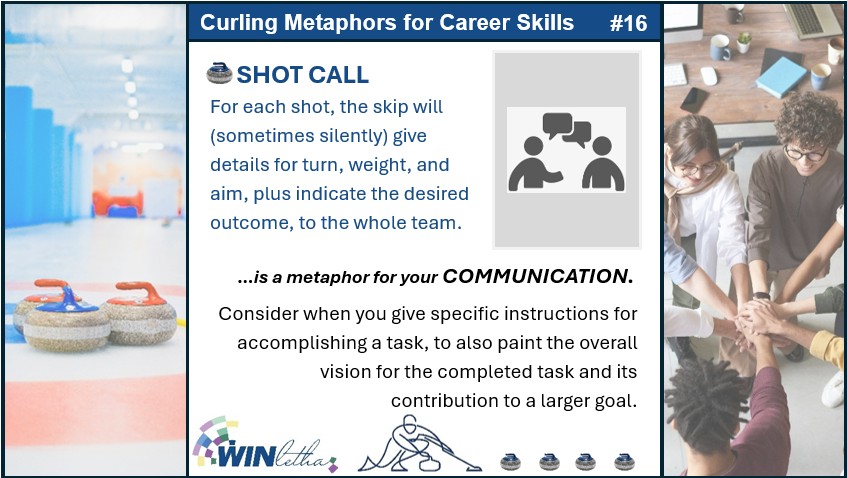
In curling, before every shot, the skip provides direction.
They indicate:
- Turn (which way the stone will rotate)*
- Weight (how hard it should be thrown)
- Line (where to aim)
But strong skips don’t stop there.
They also communicate the intended outcome:
- “Tap this back to be second shot.”
- “Guard the center to close the port.”
- “Roll behind cover to force a draw.”
- “Split the house to avoid a double.”
The team knows not just how to execute, but why the shot matters.
That distinction is everything.
Instructions vs. Communication
Many leaders are good at giving instructions:
- “Send this by Friday.”
- “Adjust the budget.”
- “Call the client.”
- “Revise this section.”
Those are mechanics.
But when people only receive mechanics, they:
- Execute narrowly.
- Miss opportunities for better solutions.
- Struggle to adapt when conditions change.
- Feel disconnected from the bigger goal.
Clarity of steps is helpful. Clarity of purpose is transformative.
Vision Creates Better Execution
People make stronger choices without constant oversight when they understand:
- The larger objective
- The trade-offs involved
- The desired outcome
- The strategic context
In curling, if the stone drifts slightly, sweepers can adjust in real time, because they understand the goal.
If they only knew “throw it there,” they would be reactive instead of responsive.
The same applies at work.
Especially as You Step Into Leadership
As professionals grow into broader leadership roles, communication becomes less about doing, and more about aligning.
Your job shifts from executing tasks to:
- Creating clarity
- Setting direction
- Connecting actions to outcomes
If you only communicate the “how,” your team depends on you for constant recalibration.
If you communicate the “why,” they gain autonomy.
And autonomy builds capacity.
What This Looks Like in Practice
Instead of: “Generate the monthly report.”
Try: “We have a decision soon about a purchase, so as you generate the monthly report, focus on the budget section being clear.”
Instead of: “Get the vendor’s delivery date.”
Try: “Talk with the vendor to learn how their delivery is tracking and what date range we need to accommodate to keep our client’s schedule.”
Now the task connects to impact.
That is leadership communication.
The Silent Signal
In curling, sometimes the skip doesn’t shout the shot call. The signals can be subtle, but clear.
Leadership doesn’t require volume.
It requires intentional clarity.
As the Games continue…
This is the sixteenth in a 20-day Olympic curling series exploring leadership lessons embedded in the sport.
Tomorrow’s lesson looks at risk of familiarity, and how situational awareness helps find the path to the button.
Until then, call the shot. And make sure everyone understands the outcome you’re aiming for. 🥌
* To make the travelled path more predictable, each stone is intentionally thrown with a rotation. It will spin clock-wise or counter-clockwise. Curlers though, don’t reference a clock face. They use the term “in-turn” when their throwing wrist twists from being inward to their body, to away from their body. So for a right-handed player, that’s clockwise, and for a left-handed players, that’s counter-clockwise. From “The History of Curling”, 1890, page 412, “While the direction given by the skip is elbow in or elbow out, the player must remember that it is the wrist that communicates the tworl to the stone….The twist will direct it in the desired curve, and its effect will be felt most in the dying moments of the stone’s career.”