
One of the most important strategic elements of curling has nothing to do with any single shot.
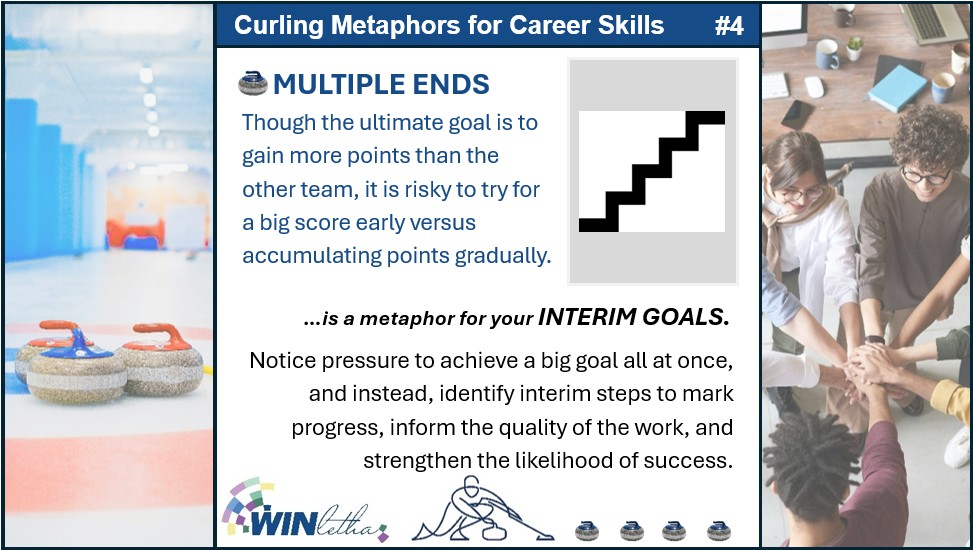
It’s the fact that the game is played in multiple ends.*
Teams don’t need to score everything at once. In fact, trying to force a big score early in the game can introduce unnecessary risk and backfire quickly.
Strong teams focus on accumulating points gradually, learning from each end, and adjusting strategy as conditions change and as they get closer to their goal.**
Why curling rewards patience
Every end offers information:
- How the ice is behaving
- How opponents are playing
- Which strategies are working
- Where risk is increasing
Teams that chase a big result too early often give up control of the game. Those that stay patient are able to take what’s available, identify and maximize surprise opportunities, and build incrementally. They’re more consistent, and more successful.
The career version of the same mistake
In professional life, big goals are everywhere:
- Promotions and salary bumps
- Revenue targets and rewards
- Major projects or special access
The pressure to achieve them quickly can be intense. And when progress feels slow, it’s tempting to do more, push harder, or skip steps.
But progress without structure often increases risk rather than results.
Why interim goals matter
Interim goals serve three important purposes:
- They make progress visible
- They provide feedback on quality and direction
- They build confidence and momentum
Without them, it’s hard to know whether effort is effective, a fluke, or just exhausting.
Like in curling, interim goals allow you to adjust strategy before the stakes get too high.
How to “win the end” at work
You don’t need to shrink your ambition. You need to stage it.
Try asking:
- What does meaningful progress look like in the next 90 days?
- What signals will tell me I’m on the right path?
- Where can I reduce risk while still moving forward?
Small wins don’t diminish big goals. They strengthen them.
As the Games continue…
This is the fourth in a 20-day Olympic curling series exploring career and leadership lessons inspired by small details of the sport.
Tomorrow’s lesson shifts from pacing to pausing, and the value of refueling.
Until then, resist the urge to force the big win… and focus on winning the end you’re in. 🥌
* Mixed Doubles games have 8 ends and take around two hours to play. The four-person games have 10 ends and take close to three hours to play. If a team ‘scores big’ in the first end, there is still a lot of game left for their opponent to catch up.
** These weedy details are about comebacks: In a round robin game at the 2024 Scotties Tournament of Hearts (i.e. the Canadian Women’s national championships), after the first three ends, Team Northwest Territories was down 0-7, but they persevered, and got to a tie score after nine ends, and won the game 10-9. Closing a gap like that is difficult but it would have been impossible prior to the Free Guard Zone rule. Prior to the rule, the opponent would just keep throwing take-outs and removing your stones. By the 1990’s, this approach happened often, even when there wasn’t a big early lead, and it was quite boring for fans to watch, which didn’t excite sponsors. In 1993, the first “Free Guard Zone” rule was established. It essentially said that a guard can’t be removed until after three rocks were in play. In 2002, it increased to four rocks. In 2017, it increased to five rocks. In 2023, a companion rule was added to say that through the first five rocks, a guard touching the center line couldn’t be “ticked” off the center line even if it stayed in play. This progression of the rules is what gives teams who are behind, some tools for a potential comeback, which makes it exciting for everyone. The rules for Mixed Doubles, first crafted in 2008, intentionally enforce lots of rocks in play. Per Rule R17(e), no stone (so not just guards but any stone in play) can be moved to an out-of-play position prior to the delivery of the fourth stone.