
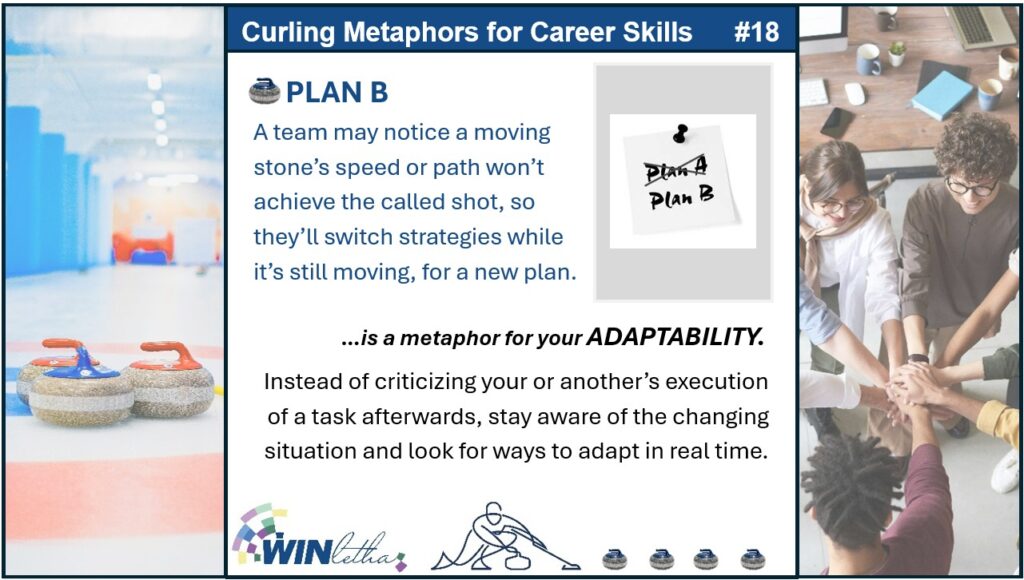
In curling, there are moments when you know.
As the stone travels down the ice, the team can see:
- It’s slightly heavy.
- It’s losing its line.
- It’s curling more than expected.
And in that split second, they face a choice.
Wait for it to finish and critique the result.
Or switch strategy while it’s still moving.
They may change the call:
- Instead of drawing to the button, make a good guard.
- Instead of tapping back, get a good angle on a freeze.
- Instead of rolling right, roll left.
The shot isn’t what was intended.
But it can still be useful, and strategic.*
That is adaptability.
The After-Action Habit
Many professionals are strong at post-mortem analysis.
After a project:
- What went wrong?
- Who missed what?
- Where did execution fail?
Reflection is valuable.
But leadership maturity shows up earlier.
It shows up in noticing drift before impact.
Adaptability vs. Criticism
When something isn’t going according to plan, the instinct can be to:
- Tighten control
- Double down
- Wait to see how bad it gets
- Or assign fault later
Adaptability asks a different question: Given what’s happening now, what is the best achievable outcome?
It shifts from: “This isn’t what we planned.” To: “What’s the smartest adjustment available?”
That is strategic agility.
The Cost of Waiting
If you let the stone finish its full path before reacting:
- You lose options.
- You reduce flexibility.
- You increase risk of consequences.
In leadership, that might look like:
- Ignoring early warning signs on a project
- Dismissing subtle team disengagement
- Hoping market shifts correct themselves
- Sticking rigidly to a timeline that no longer fits
Small course corrections early prevent large corrections later.
Real-Time Awareness Requires Humility
Switching to Plan B midstream requires admitting:
- The original call may not land.
- Conditions have changed.
- The initial plan needs revision.
That’s not weakness.
It’s strength.
Adaptability is not the absence of planning. It’s the ability to re-plan quickly.
What This Looks Like at Work
You might practice real-time adaptability by:
- Adjusting meeting goals when new information surfaces
- Re-scoping a deliverable instead of forcing completion
- Changing sequencing when dependencies shift
- Clarifying expectations mid-project instead of after disappointment
The key is this:
Don’t wait for the miss to be obvious.
If you can see drift then act.
As the Games continue…
This is the eighteenth in a 20-day Olympic curling series exploring leadership lessons embedded in the sport.
Tomorrow’s lesson looks at the patience of blanking an end.
Until then:
Call Plan B before it stops moving. 🥌
* It can also happen that a stone that misses the intended shot, actually makes a better shot that either wasn’t considered or was deemed too difficult or risky to do. i.e. there can be lucky breaks. Curlers will shrug, chuckle, and apologize to the opposition for making a great play that wasn’t the actual call.