
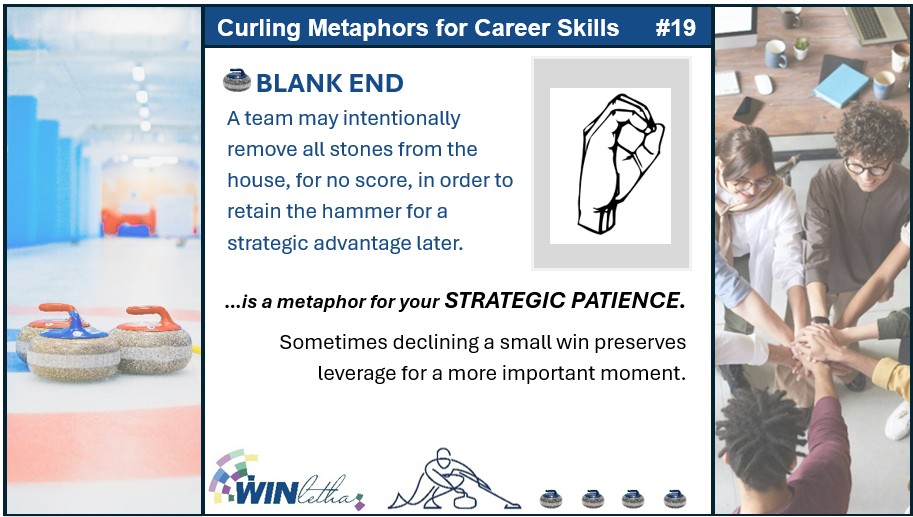
In curling, there are moments when a team could score one point.
But they choose not to.
Instead, they intentionally “blank” the end by clearing stones so no one scores, in order to keep the hammer (last rock advantage) for the next end.*
To the casual viewer, it may look like a missed opportunity.
It isn’t.
It’s strategic patience.
The Pressure to Produce
Many professionals feel constant pressure to:
- Show progress
- Demonstrate value
- Capture small wins
- Deliver visible results
The instinct is to take the point. Close the deal. Finalize the decision. Send the draft. Secure the incremental gain.
But not every small win strengthens your long-term position.
Sometimes it weakens it.
Short-Term Points vs. Long-Term Leverage
Blanking an end is a calculated choice.
You give up an immediate score to:
- Retain advantage
- Control timing
- Shape the next round
- Increase your probability of a larger gain
That requires discipline – accepting that the scoreboard stays the same.
Leadership often requires similar restraint.
Strategic Patience in Practice
You may practice a “blank end” when you:
- Decline a marginal opportunity to protect capacity for a bigger one
- Ask for a pause in a tense conversation
- Choose not to correct a minor issue in order to preserve trust
- Pass on a short-term revenue boost that compromises long-term positioning
To others, it may look like hesitation.
But it’s intentional.
Why This Is Hard
High performers are wired to produce.
Waiting can feel like:
- Falling behind
- Losing momentum
- Missing out
- Appearing inactive
But strategic patience is not passive.
It’s a decision to play the long game.
It says: I’m not optimizing for this moment. I’m optimizing for a larger outcome.
The Maturity Shift
Earlier in a career, momentum matters most.
Later, timing matters more.
You begin to see:
- Not every issue requires immediate resolution.
- Not every opportunity deserves pursuit.
- Not every advantage should be spent right away.
When to Blank the End
Ask yourself:
- Does taking this “point” reduce my flexibility later?
- Am I reacting to pressure or acting from strategy?
- Would waiting increase clarity or positioning?
- Am I chasing visible progress instead of meaningful progress?
If so, restraint may be the smarter play.
As the Games near the end…
This is the nineteenth in a 20-day Olympic curling series exploring leadership lessons embedded in the sport.
Tomorrow’s final article will reflect on how leadership, like curling, is never about one shot.
Until then:
Remember that sometimes the strongest move is choosing not to score. 🥌
* Opponents may anticipate your desire to blank the end, and they will be intentional in placing their stones in an effort to “avoid a blank” and “force” you to score. This leads to phrases like “The force is on!”