
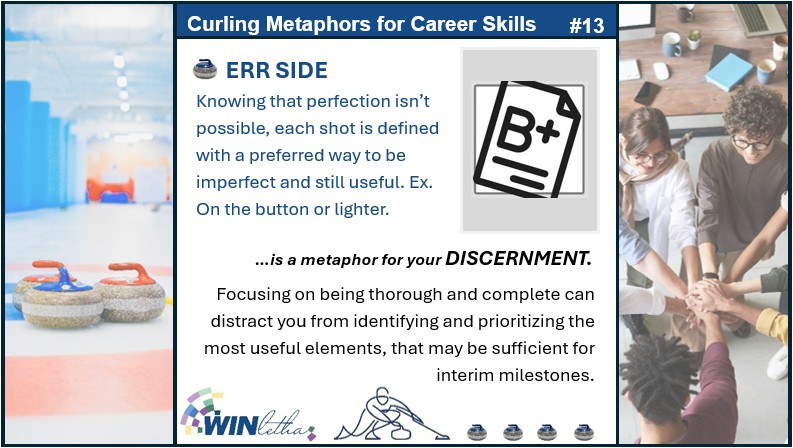
In curling, teams know something important: Perfection isn’t guaranteed.
So instead of defining only the ideal shot, they define the err side – the preferred way to be imperfect and still helpful.*
For example:
- “On the button… or lighter.”
- “Tight line is okay.”
- “Heavy is better than short.”
They plan the miss.
Because in a dynamic game, exact precision is rare. But usefulness can be maximized.
The Discernment Shift
Many professionals are trained to be thorough, complete, and exhaustive.
That mindset earns strong grades and early credibility.
But at higher levels of leadership, thoroughness without discernment can slow momentum.
You can:
- Over-research
- Over-polish
- Over-prepare
- Over-include
And still miss what’s most strategic.
Discernment asks: What matters most right now?
Not: How do I make this perfect and undeniable?
Sufficient for the Moment
Not every deliverable is a final product.
Some are:
- Drafts and prototypes
- Interim updates
- Decision frameworks
- Early models
- Pilot proposals
When you treat every milestone as a finished masterpiece, you waste energy and delay feedback.
Leaders clarify:
- What’s the purpose of this step?
- What level of precision is appropriate?
- If we miss, where is the most useful place to land?
That is strategic thinking.
Planning the Imperfection
Defining the “err side” forces you to prioritize.
If this presentation isn’t flawless:
- Is it better to be concise or comprehensive?
- Is it better to show early numbers or wait for polished ones?
- Is it better to propose boldly or hedge cautiously?
- Is it better to connect informally or be structured?
You choose your bias intentionally.
Instead of hoping for perfect, you design for useful.
Why This Matters for Emerging Leaders
As professionals grow into leadership roles, expectations shift.
You’re no longer evaluated solely on execution quality. You’re evaluated on judgment.
Discernment signals maturity:
- You understand trade-offs.
- You recognize diminishing returns.
- You know when good enough advances the work.
Perfection seeks certainty. Discernment seeks progress.
What This Looks Like in Practice
You might apply this by:
- Sending a draft earlier than feels comfortable
- Cutting slides that add detail but not clarity
- Stopping analysis when the decision threshold is met
- Clarifying what “version 1” truly requires
And explicitly stating: If we’re off, I’d rather be slightly X than Y.
That is leadership language.
As the Games continue…
This is the thirteenth in a 20-day Olympic curling series exploring leadership lessons from small but powerful elements of the sport.
Tomorrow’s lesson looks at delegating, and the value of working as a team.
Until then, don’t chase flawless.
Choose your miss. 🥌
* Like other elite athletes, curlers apply positive psychology, and know the ironic process theory (or the pink elephant paradox.) Rather than saying what to avoid, they say what the preferred tolerance is. Golfers will relate to the difference between “don’t hit the ball into the lake on the right” (which then has you thinking about the lake) versus “just hit it straight or to the left”.