
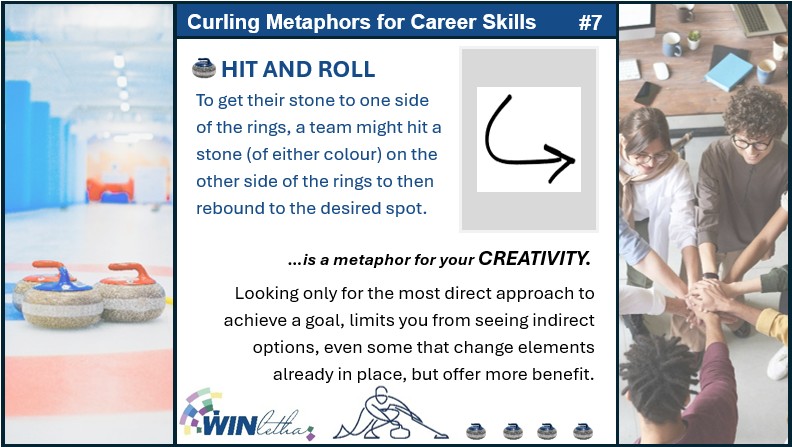
Some curling shots look almost wrong – until they work.
Instead of aiming directly for the target, a team will intentionally hit another stone, sometimes even one of their own, so that the rebounding stone rolls into the ideal position.*
It’s called a hit and roll.
The shot only works if the team can see beyond the most obvious path.
Why curlers use indirect shots
Direct shots are simpler, but they’re not always available.**
Ice conditions, stone placement, and game strategy often make a straight path either too risky or ineffective. In those moments, creative teams consider how changing what’s already in play could open up better options.
The goal doesn’t change. The path does.
The workplace version of the same challenge
In professional life, we often default to direct solutions:
- Asking for the promotion
- Pushing harder on a stalled project
- Escalating an issue
- Applying pressure where progress has slowed
Sometimes that works. Sometimes it doesn’t.
When direct paths stall, creativity comes from asking a different question:
- What could I influence indirectly?
- What existing structure could be reshaped?
- Who else might unlock movement?
- What assumption about “how this must work” am I holding?
Creativity isn’t chaos – it’s strategy
The hit and roll isn’t improvised. It’s deliberate, practiced, and calculated.
Creative solutions at work are the same. They aren’t about abandoning structure – they’re about seeing more options within it.
Indirect moves often:
- Reduce resistance
- Build unexpected allies
- Shift dynamics quietly
- Create space where none seemed to exist
When indirect beats direct
If you’re stuck, consider whether:
- A conversation with a peer could move things faster than escalating
- Reframing the problem could unlock support
- Adjusting scope or sequence could change momentum
- Improving something adjacent could create leverage
Progress doesn’t always require force. Sometimes it requires angle.
As the Games continue…
This is the seventh in a 20-day Olympic curling series exploring career and leadership lessons inspired by small details of the sport.
Tomorrow’s lesson moves from creativity to perspective – and how curlers can get a fresh take when they need it the most.
Until then, when the straight line isn’t working, look for the rebound. 🥌
* In the rule book’s Glossary of Terms, a hit is the “removal of a stone from the playing area by hitting it with another stone.” A roll is “the sideways movement of a curling stone after it has struck a stationary stone.” And the exciting hit and roll is “a stone that knocks an opponent’s stone out of play, and then rolls to another position in play.” The angles of the redirects, and the distances of the rolls, can be stunningly dramatic.
** A variation of the hit and roll is when the roll itself is meant to hit another rock. If it’s done with the stones in a straight(ish) line, it’s a runback. If it’s done on an angle, it’s an in off. A famous in off was in 2005 by Jennifer Jones to win the Scotties Tournament of Hearts, and a very similar shot was made in 2026 by Taylour Stevens – and here is a side-by-side video of both creative and clutch shots.