
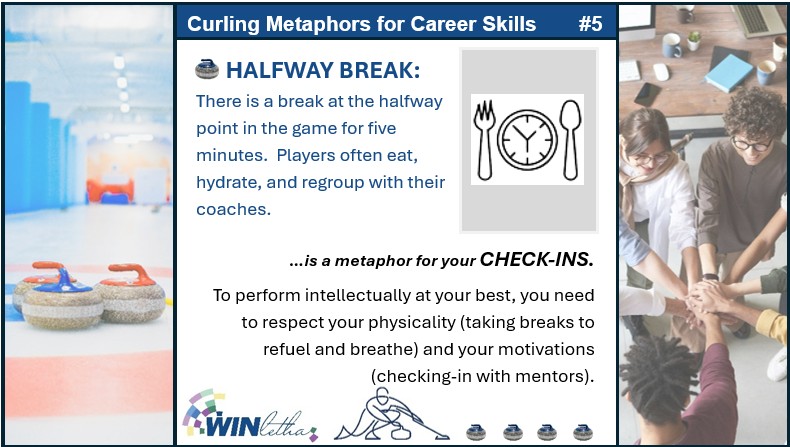
Right in the middle of a competitive curling game, everything stops.
There’s a scheduled five-minute break at the halfway point.* Players step off the ice, grab food, hydrate, and reconnect with their coaches.**
It’s not dramatic, but it’s deliberate.
No one questions whether the break is deserved. No one rushes through it to prove commitment.
The goal is simple: return to the ice sharper than before.
Why the halfway break matters
Curling is as much a mental game as a physical one. Focus, judgment, and communication matter more in the later ends when fatigue, pressure, and stakes are higher.
The halfway break protects performance by:
- Supporting physical energy
- Resetting attention
- Realigning strategy
- Reinforcing confidence and motivation
Ignoring these needs doesn’t create toughness. It creates misses.
The professional equivalent of the same pause
Many professionals choose to, or feel pressure to, push straight through their days, weeks, and beyond.
- Back-to-back meetings
- Long projects with consecutive urgent deadlines
- Continuous decision-making
- Unending To Do lists
Over time, performance doesn’t just slow, it becomes less precise.
Strong intellectual work depends on physical and emotional capacity. When those are depleted, even the best intentions fall short.
Check-ins aren’t indulgent, they’re strategic
Effective check-ins do two things:
- They respect your physicality
- They reconnect you to purpose and perspective
This might look like:
- Taking real breaks instead of multitasking through them
- Hydrating, moving, and breathing intentionally
- Checking in with a mentor, coach, or trusted peer
- Asking, “What actually matters in the next phase?”
These moments aren’t lost time. They improve what follows.
Finishing strong requires a reset
In curling, a team that would stay in full ‘game mode’ through the halfway break wouldn’t gain an advantage. They’d lose one.
The same is true at work.
The game doesn’t stop because players are weak. It pauses so they can finish strong.
As the Games continue…
This is the fifth in a 20-day Olympic curling series exploring career and leadership lessons inspired by small details of the sport.
Tomorrow’s lesson looks at what each player does before throwing a stone.
Until then, notice where a purposeful pause might improve – not interrupt – your performance. 🥌
* Rule C6(j)ii. imposes 5 minutes at the completion of the end that defines the halfway point in the game. In Mixed Doubles that’s between the 4th and 5th end, and in four-person games that’s between the 5th and 6th end, and is often called the “5th end break”.
** Fresh weeds. Until very recently, players and coaches were prohibited from communicating through the game except during specified breaks. So the halfway break was an important moment for exchanging observations, analyses, and strategy ideas. The game did not originally develop with coaches, or rely so heavily on today’s time measurements and statistics. As these advantages progressed, perhaps the rules were written to enforce a form of fairness. As recently as 2024, rule C2(o) said “While a game is in progress, the coach, the alternate player, and all other team officials are prohibited from communicating with their team or being within the playing area except during specifically designated breaks or a team time-out. The restriction applies to all verbal, visual, written, and electronic communication, including any attempt to signal for the implementation of a team time-out.” A violation meant removal from the coach’s bench for that game. Pretty strict compared to baseball coaches with their hand signals, ice hockey coaches with their whiteboards standing right behind the team’s bench, the basketball coaches pacing and engaging from the sideline, and the football coaches with headsets to give instructions to their quarterbacks through a speaker in their helmets. Modern sports have expanded the role of the coach as an integral part of the team, and the 2025 rules indicate a pivot. Rule C2(p) now says “While a game is in progress, the coach, the alternate player, and all other team officials may, if the venue layout allows, communicate with their team from their position in the team official field of play. This only applies when a team is the non-delivering team. Yelling is not allowed, and the team must not distract the delivering team.”