
One of the most misunderstood parts of curling isn’t the sweeping or the scoring – it’s the game clock.
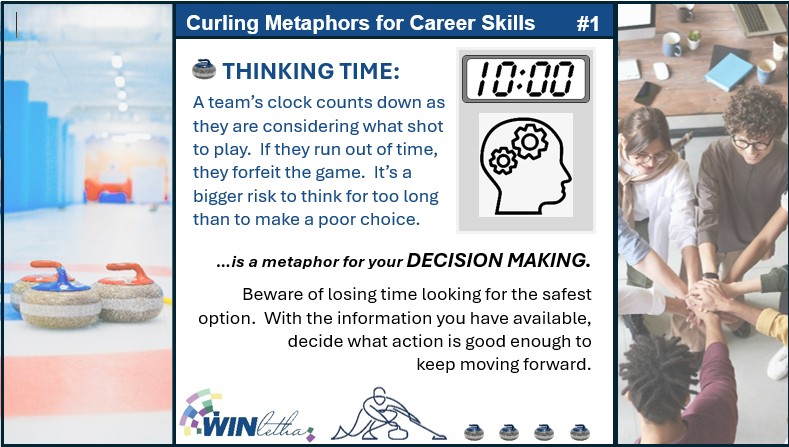
In competitive curling, teams are given a fixed amount of thinking time.* That clock runs while they discuss strategy, debate options, and decide which shot to play. If a team runs out of time, they don’t just lose their turn, they forfeit the entire game.**
What surprises new fans is this: The bigger risk for a team isn’t from choosing the wrong shot. It’s from taking too long trying to choose the perfect one.
Indecision is a decision, and often it’s the worst one.
Thinking time on the ice
At the elite level, curlers are highly skilled, deeply experienced, and capable of extraordinary shots. But no amount of talent pauses the clock.
Every decision is made with:
- Incomplete information
- Changing conditions
- Conflicting opinions
- Real consequences
Sound familiar?
Teams that succeed learn to narrow options quickly, commit to a plan, and execute. Hesitation is far riskier than a well-considered imperfect choice.
The career version of the same clock
In your career, you also have a relationship with time, and may be choosing to hesitate and think “a little bit longer.”
You may recognize it as:
- Waiting too long to apply for a role until you feel “ready”
- Overanalyzing feedback instead of acting on it
- Delaying a tough conversation because the timing isn’t perfect
- Holding off on a decision until you have just a bit more data
Like curling, work rarely offers perfect information. Momentum matters. Opportunities move. Context shifts.
And sometimes, by the time you feel certain, the moment has already passed.
“Good enough” keeps the game alive
In curling, teams ask:
- Do we have enough information to act?
- Are we aligned enough to commit?
- Can we live with – and adjust to – the result?
Those same questions serve you well at work.
Progress often comes not from choosing the safest option, but from choosing a good enough one and staying in motion.
As the Games begin…
Over the next 19 days of the Olympics, I’ll share one small detail from the sport of curling and connect it to a practical career or leadership lesson.
Some may simply confirm what you already know. Others might arrive exactly when you need to move into action.
Tomorrow, we’ll talk about what curlers do to start and finish every game.
* To be specific, at the Olympics: Each Mixed Doubles team, for an 8-end game, starts with 22 minutes of thinking time. Each 4-person team, for a 10-end game, starts with 38 minutes of thinking time.
** Welcome to deep in the weeds. The statement about forfeiting the game is in the context of World Curling Federation events, like the Olympics. World Curling Rules of Competition July 2025, Rule C6(n) says “Each team must complete its part of a game within the time given or forfeit the game.” It can be a little different at an event following the Curling Canada Rules of Curling for Officiated Play. Under Rule 17(3), if the allotted time of a team expires before the team’s final stone of the game has reached the nearer tee line, it’s not an automatic forfeit. There are a few scenarios that the umpire needs to go through, but essentially, if the non-offending team has no stones left, then the end is considered over and scored as it lies, and if they do have stones left, and they aren’t already winning, then they can continue to use their time to attempt to tie or win the game.